In short
A drawer brings the contents to you; a cupboard asks you to go and find them. Deep drawers on full-extension, soft-close runners hold plates and pans in one visible layer, and inserts cut to what you own keep them in place. Keep cupboards for tall items, larders and corners.
The problem at the back of the cupboard
In a deep cupboard, the thing you need is always at the back. You kneel, you move three other things, you reach, and you knock over what you were trying to avoid. Behind a door, half of the space is hard to see and harder to reach. It is storage you pay for and rarely use.
A drawer solves this by changing the direction of access. It comes out to you. Everything inside is visible from above and within reach from the front. Nothing sits behind anything else. That one change is why a kitchen planned around drawers feels so much easier to live with.
How should drawers be sized and stacked?
A wide, deep drawer holds plates, bowls and pans in rows. Nothing is stacked, so nothing has to be lifted out to reach what lies beneath. A stack of eight plates in a cupboard means lifting seven to get to the eighth. In a drawer with pegs or a divider, each plate stands on its own.
Pots and pans are the clearest case. They are heavy, awkward and different in shape. In a drawer they sit side by side, with lids stored upright in a divider beside them. You see the whole collection at once and take the one you want, with one hand and no noise.
Drawers also use the corners of a room more sensibly than shelves behind a door. A base unit fitted with drawers has no dead space above the stored goods, and the top drawer can be shallow for cutlery and tools while the lower ones go deep for the heavy items.
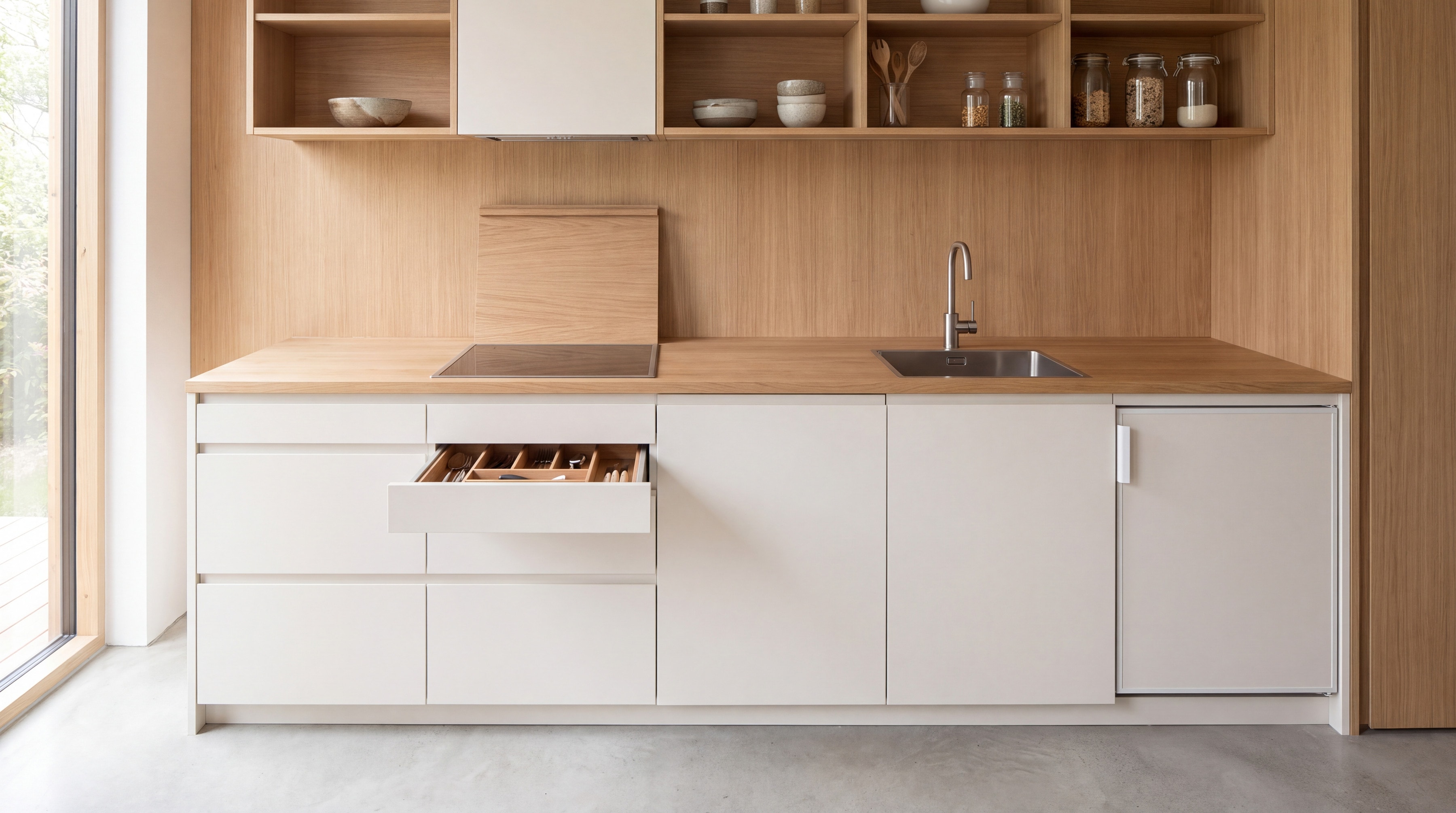
Plan the heights of the drawers in a column. Shallow drawers at the top hold cutlery, tools and small items, at a height where you can see straight in. Medium drawers below take plates and bowls. The deepest drawer sits at the bottom, where the heaviest pans can be lifted out with the legs doing the work. Some cooks prefer a hidden drawer behind a door for glasses or baking tins, so the front of the cabinet stays quiet.
Why the runners matter most
The hidden part of a drawer matters most. Full-extension runners let the whole drawer come out, so the back is as reachable as the front. Soft-close mechanisms catch the drawer in the last few centimetres and bring it to a quiet stop. A heavy drawer should feel light and move without a sound.
People notice this every day without being able to name it. It is the difference between a kitchen that feels solid and one that feels cheap. Runners are also rated for a load, and a drawer full of crockery is heavy. Ask what the rating is for the drawers you are planning, and ask that the box and the fixings are sized to match.
Good drawers are adjustable after they are fitted. The front can be moved a millimetre up, down or sideways, so the gaps stay even as the house settles and the timber moves with the seasons. That is a small detail with a long life.
Why inserts should be cut to what you own
A generic drawer insert is a compromise. An insert cut to the size of your own plates, glasses and tools is a fit. It stops things sliding when the drawer closes and makes tidying a matter of seconds, because every object has a place.
Start from a list. Count the plates, bowls, glasses and mugs. Measure the largest of each. Note the knives, the long utensils, the chopping boards and the baking trays. A drawer for knives wants a protected slot for each blade. A drawer for spices wants a shallow angle so labels face up. A drawer for baking trays wants vertical dividers, so a tray lifts out without disturbing the others.
The same thinking applies to the drawer beneath a sink, which can be shaped around the pipes, and to a drawer for waste, which keeps bins sorted and out of sight behind a closed front.
Where a cupboard still makes sense
Drawers are not a rule for every part of a kitchen. A tall pull-out larder keeps dry goods visible and reachable on both sides. A cupboard with a door is the right home for a tall stock pot, a large mixer or a vacuum cleaner. Wall units are cupboards by nature, and they are fine for things you use occasionally.
Narrow drawers are the one place to be careful. Below roughly thirty centimetres wide, a drawer holds little, and a door with a pull-out inside can be more useful. The aim is not to use as many drawers as possible. It is to give each thing the type of storage that makes it easiest to reach.
Corners deserve a special mention. A plain corner cupboard swallows space, and what is stored there is almost impossible to reach. A pull-out corner fitting, which swings or slides the shelves into view, turns that dead space into usable storage. It costs more than a fixed shelf, and for a corner that you would otherwise never open, it earns its place.
Who benefits most from drawers?
Drawers are kinder to the body. There is no kneeling, no stretching and no twisting to look into a dark space. For anyone with a bad back, stiff knees or a shorter reach, the difference is large. They also suit a household with children, because a low drawer can hold items a child is allowed to reach, with the sharp ones higher.
They are easier to keep clean as well. You can lift out the contents, wipe the inside and put everything back in a few minutes. In a deep cupboard, that task is put off for years.